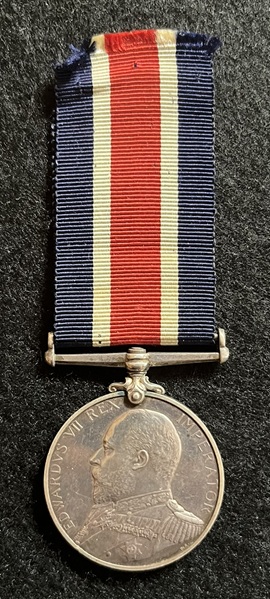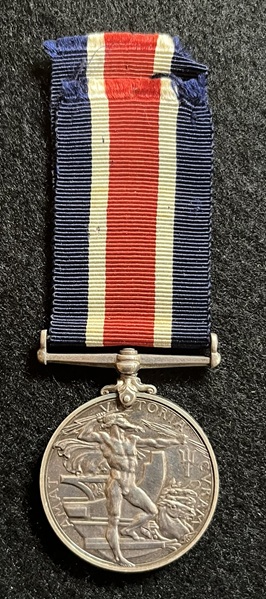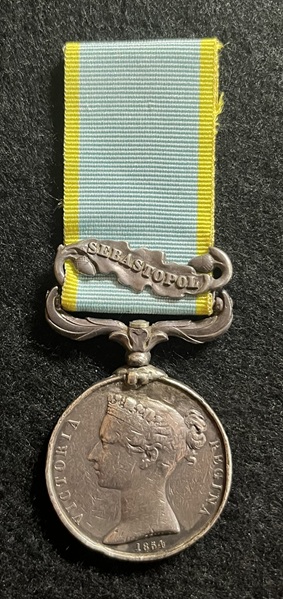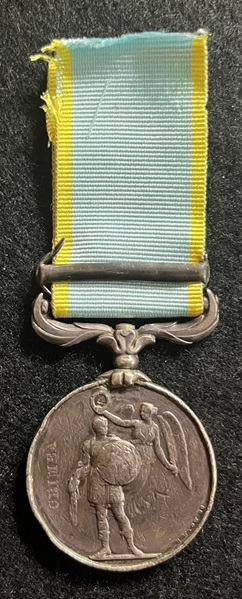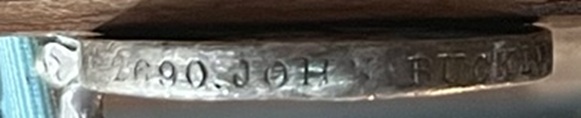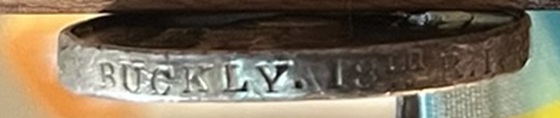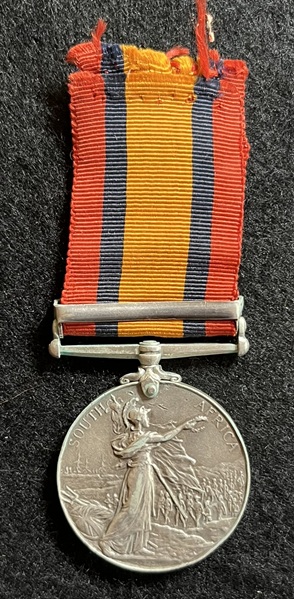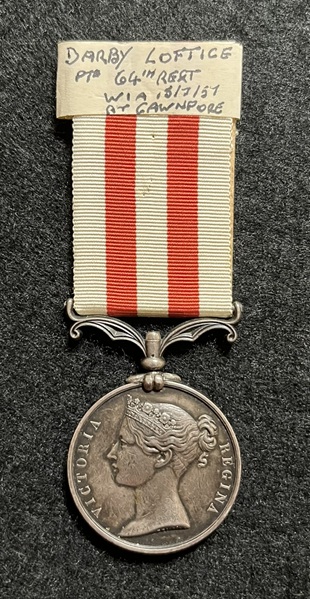
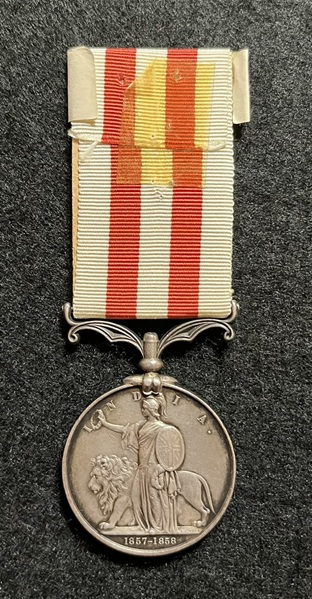
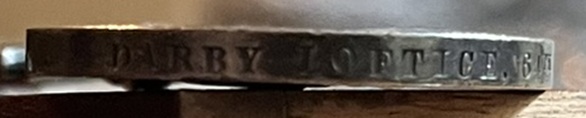

 One. India Mutiny Medal 1857-1859. Named to DARBY LOFTICE 64TH FOOT. Darby Loftice enrolled in the 64th Foot from Liverpool sometime in October 1848 with service number 2758. On 9 February 1849, he embarked for overseas on the troop transport ship Earl of Balcarras, arriving in Bombay on 24 May that year.
He saw active service during the Indian Mutiny, being wounded on 15 July 1857 at Cawnpore. The United Kingdom's National Army Museum notes that 'Cawnpore was a major crossing point on the River Ganges, and an important junction, where the Grand Trunk Road and the road from Jhansi to Lucknow crossed. In June 1857 the sepoys there rebelled and laid siege to Major-General Sir Hugh Wheeler's garrison. Wheeler had retreated to an
entrenchment outside the city. Nana Sahib, a local ruler who had suffered from the British seizure of his estate, led the rebels. For nearly three weeks, under constant fire and a burning sun, 1,000 Britons awaited rescue. On 25 June 1857, Nana Sahib learnt that a British relief force was approaching Cawnpore and offered Wheeler's garrison safe passage downstream to Allahabad (now Prayagraj). The British boarded waiting boats and
were then fired upon. Any men who survived the ambush were immediately killed. On 15 July 1857, the surviving 120 women and children were imprisoned. When it was heard that the British were near, the prisoners were murdered and their bodies thrown down a well. Major-General Sir Henry Havelock's relief force reached Cawnpore a day later, on 16 July 1857. After carrying out indiscriminate reprisals against both the guilty and innocent,
Havelock marched northwards towards Lucknow, but was forced to turn back.' General Havelock's force had begun its march from Allahabad on 7 June 1857. His column, with which he intended to attempt to relieve Cawnpore and then Lucknow, was relatively small in size. The force at his disposal was approximately 1,000 British Infantry, 150 Sikh soldiers, and 30 Irregular Cavalry. The force contained small parts of the 1st Battalion Bengal
Artillery; 64th Foot; 78th Highlanders; 5th Fusiliers; 84th Foot; seven companies of the 90th Light Infantry; and the Madras European Fusiliers, and had a total of 8 guns. Havelock’s force advanced down the Grand Trunk Road. News came to the Advanced Guard under Major Renaud of the Madras Fusiliers that at Cawnpore, General Wheeler had been forced to capitulate. On 12 July, General Havelock’s force met the mutineers’ force of 3,000 men
and 12 guns at Fathepore. Havelock’s force routed the mutineers and continued their relentless march toward Cawnpore. Two days later Havelock’s force stormed the Pandu Nadi river where the bridge was defended by over 2,000 mutineers. It is believed that this action caused Nana Sahib to order the execution of the remaining women and children still imprisoned in the Bibighar at Cawnpore. Loftice was likely wounded during this battle.
Loftice's medal roll entry for his India Mutiny Medal notes that he served with Havelock's force and later volunteered to serve in the 31st Foot (muster rolls show that his regimental number was 839). Loftice was discharged by indulgence in May 1863. In addition to this medal, he was also entitled to a Second China Medal 1856-60 with bar Taku Forts 1860.
Medal is accompanied by electronic copy of muster rolls documenting enrollment and release, and medal roll entries, as well as a copy of his casualty details from the Tavender roll. An emotive medal to a casualty of the desparate attempt to relieve the Cawnpore garrison.
Good VF Condition $1200